Off-Site Sources
Most AI answers are built from pages you do not own.
GeoShark reads the sources behind each answer, finds the review sites, listicles and forum threads a brand is absent from, and writes the pitch to get it added.
 ChatGPT
 Gemini
 Perplexity
 AI Overview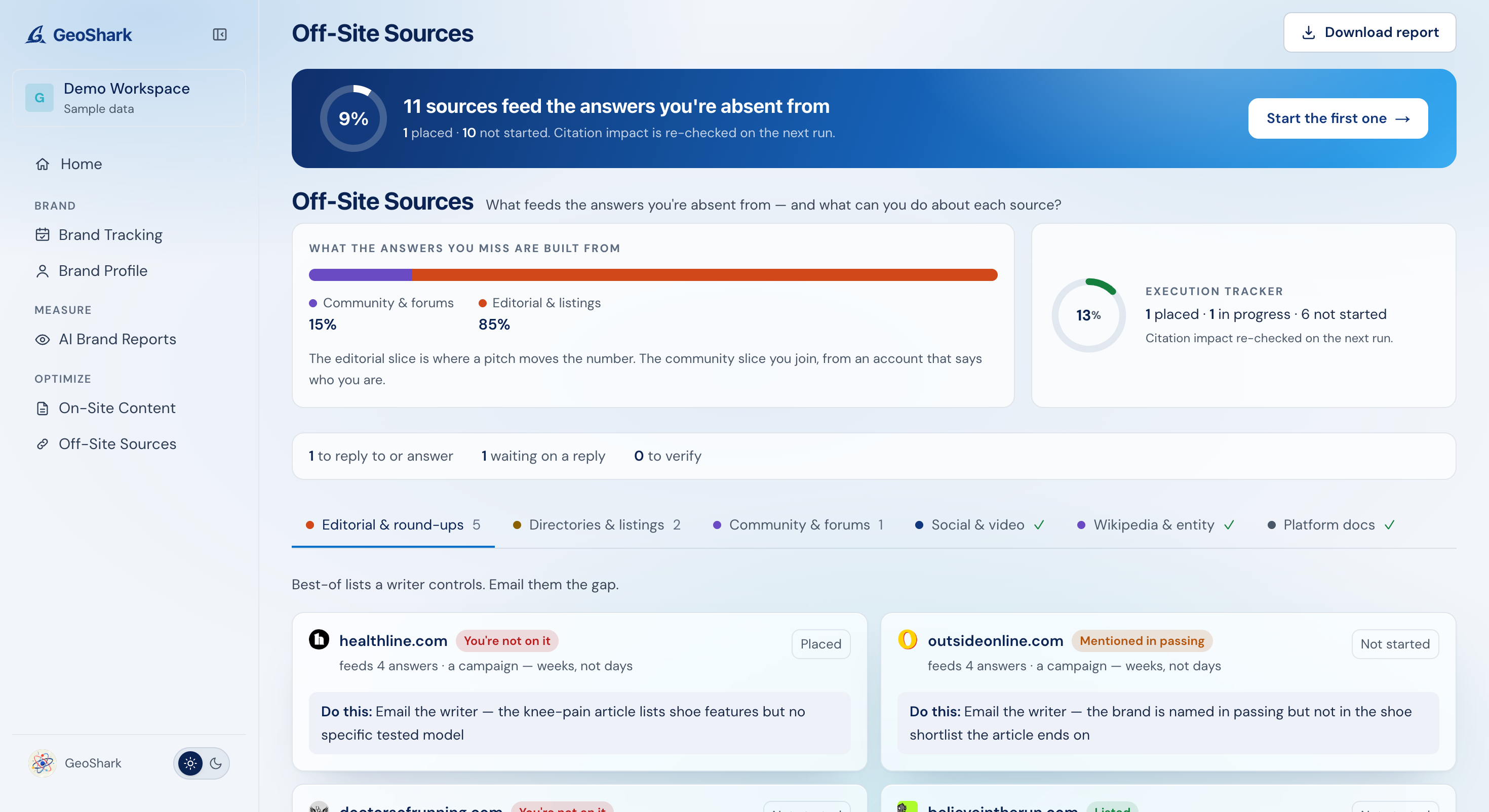
In one line
Off-site source work for GEO is getting a brand onto the third-party pages AI engines cite — the review sites, listicles and forum threads that decide a category answer more than a brand's own site does.
How it works
It reads the sources
For every answer, which pages the engine built it from, who controls them, and whether a competitor is named where the brand is not.
It picks the targets
The pages worth pitching — cited often, on questions the brand loses, and open to a submission or an update.
It drafts the pitch
A specific message per page — what to add, why it fits, and the link to the exact source.
What you get
- The third-party pages behind each answer, ranked by how often they are cited
- Which ones name a competitor and not the brand
- A drafted pitch per target page
- A deep link to the exact source, not the domain
- Who controls each page — editorial, community, retail
- The questions each placement would help win
Off-Site Sources, answered
Why does off-site matter for AI answers?
An engine writes a category answer mostly from independent pages — review media, listicles, forum threads — not from a brand's own marketing. If those pages name three competitors and not your client, no amount of on-site work puts the client in that answer. Getting onto the cited pages is the other half of the job.
Does GeoShark send the outreach for me?
No. It identifies the pages, explains why each one matters, and drafts the message. You send it from your own inbox, under your own name — an agency's relationships are the agency's, and a pitch sent from a tool reads like one.
How does it find the target pages?
From the run itself. Every answer carries its sources; Off-Site Sources groups them, keeps the ones cited on questions the brand loses, and drops the ones the brand already appears on or cannot influence.
Which plans include it?
Every plan, alongside On-Site Content, and pitches are not metered on any of them.
See the pages an answer is built from.
The sample carries a full Off-Site Sources list for Nike, pitches included. Sign in with Google and read it before you pay.